

Implants, fat transfer, or a hybrid of both — here’s how to understand your options so you can walk into your consultation with confidence.
If you’ve been thinking about adding fullness to your breasts, you’ve picked a great time to explore it. The options available today — and the technology behind them — are better than anything we’ve had before.
We recently hosted a live masterclass with board-certified plastic surgeon Dr. Hector Salazar, and the room (virtual as it was) was packed *watch the on-demand replay. The questions were great, the conversation was real, and we covered everything from implant brands to fat transfer to what “gummy” actually means. Here’s your cheat sheet.
First: “More Options” Doesn’t Have to Mean “More Confusing”
Dr. Salazar made a point right at the top that stuck with us. When a cardiologist puts in a pacemaker, the patient doesn’t get to weigh in on the brand. Breast augmentation is different — you’re an active part of the decision. That’s a good thing, even when it feels like a lot.
Think of it less like a procedure you’re scheduled for and more like finding the perfect pair of shoes. It takes time, it takes trying things on, and there’s a real “eureka moment” when you find the right fit.
Two Paths to Fullness (or a Mix of Both)
Implants
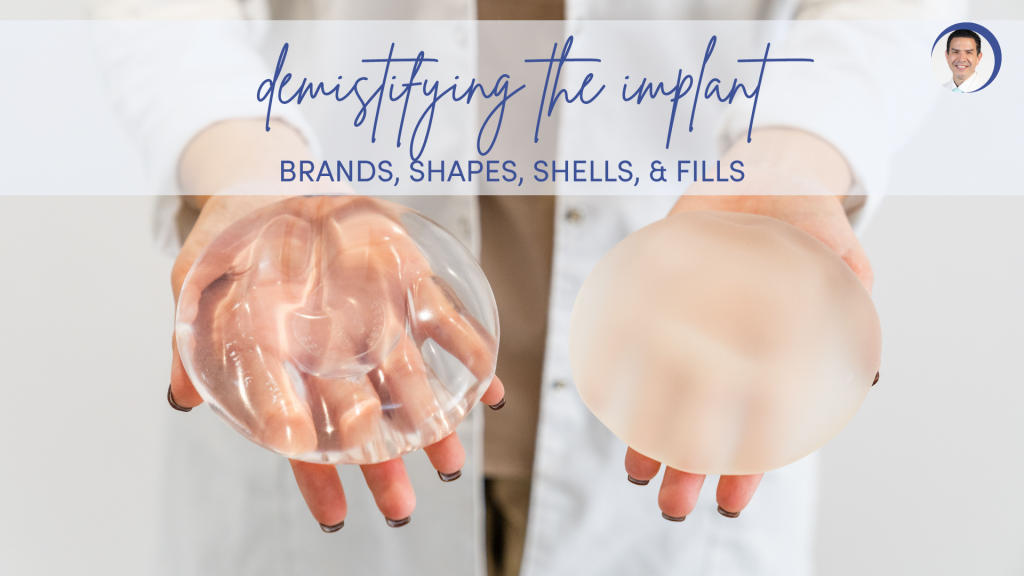
The most common route, and the most customizable. In the U.S., there are four FDA-approved brands: Mentor, Sientra, Allergan’s Natrelle, and Motiva. All are backed by major medical device companies and meet high safety standards. LJCSC uses both Natrelle and Motiva implants.
Within each brand, you’re choosing across a few key variables:
Type of fill — saline vs. silicone gel. Saline implants have a silicone shell filled with sterile salt water. They’re safe and widely used, but can ripple over time and may feel less natural. Silicone gel implants feel closer to real breast tissue, adapt quickly to your body temperature, and hold their shape better. They’re the more popular choice today.
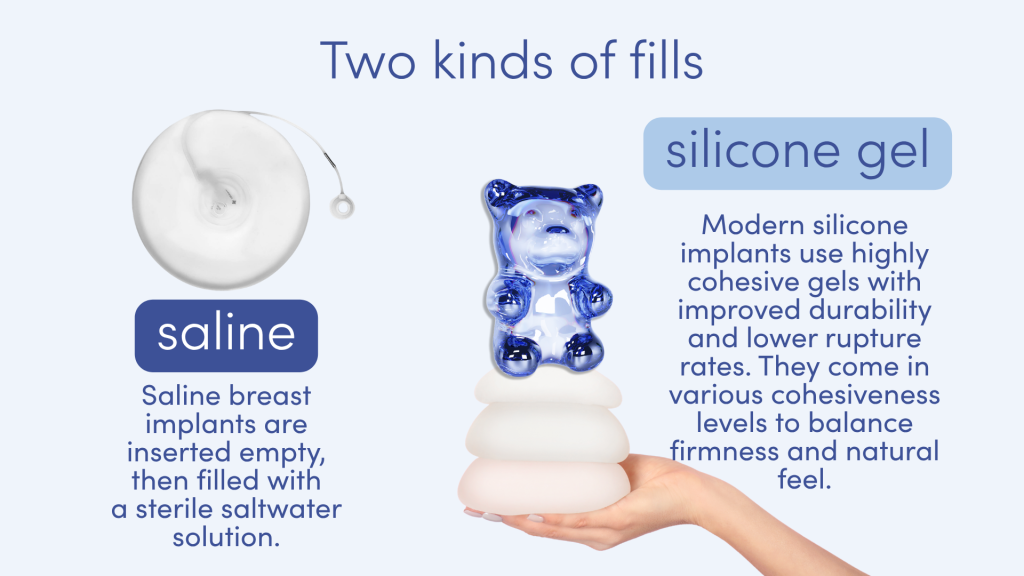
Fun fact from Dr. Salazar: jump into a cold pool with saline implants, and you might still feel that temperature difference when you get out. Silicone adapts much faster.
Cohesiveness — how firm the gel is. All current implants are technically “gummy bear” implants, meaning if you cut one open, nothing spills out. But within that, you have a spectrum. Softer implants move more naturally with the body. Firmer ones hold their shape and are great for patients with less breast tissue who want more structure. Natrelle, for example, offers three options: responsive (very soft), cohesive (firmer), and soft touch (a middle ground).
Projection — how far out the implant extends. Low projection means a subtle, natural look. A higher projection means greater upper-pole fullness and a more augmented appearance. Motiva uses the terms mini, demi, and full. Mini…if you want no one to notice. Full… if you want to turn heads. All valid — different goals, different patients.
A note on Motiva: It’s the newest brand to receive FDA approval in the U.S., but it’s been used globally for 14 years. Its standout feature is a SmoothSilk® surface — scientifically shown to produce less inflammation and lower bacterial attachment than other implants, helping the tissue around the implant stay soft and reducing the risk of capsular contracture. The data shows encapsulation rates below 1%.

Fat Transfer
If the idea of using your own body’s fat appeals to you, this is a real option — but it comes with honest limitations that Dr. Salazar was refreshingly candid about.
Here’s the deal: fat is living tissue. When it moves to a new location, it needs about three weeks to establish its own blood supply to survive. Think of it like moving into a new apartment building where all your neighbors are also brand new — nobody can share resources, and some cells won’t make it. On average, 25–35% of transferred fat gets reabsorbed by the body.
That means fat transfer is less predictable in terms of final volume, often requires multiple sessions, and can’t replicate the shape and structure that an implant provides. It adds volume. It doesn’t lift or build.
That said, it’s a beautiful option for the right patient — particularly someone with enough available fat and more modest volume goals who wants a result that’s entirely natural.
Coming soon: La Jolla Cosmetic Surgery Centre is exploring a fat-banking technology from Tissue & Cell Technologies that would let you harvest fat once and freeze it for future sessions — no repeat liposuction needed. Watch this space.

The Hybrid Approach
This is where it gets interesting. Implants and fat transfer aren’t mutually exclusive.
Here’s a real-world example: an implant is essentially a circle. If you want more cleavage, you’d need a wider circle — which also means more projection on the sides (the dreaded “side boob”). What if you just want fullness in the center? Fat grafting can do that targeted work without changing the implant size at all. Another common use: a patient who loves everything about her augmentation result but wants just a little more volume at the top of the breast. Fat grafting to the upper pole, combined with the implant’s structure, can get her there.
Capsular Contracture: What You Should Know
It comes up in almost every consultation, and for good reason. Capsular contracture happens when the scar tissue your body naturally forms around an implant starts to tighten — making the breast feel hard and sometimes changing its shape.
The good news is that the risk is lower than it’s ever been. Dr. Salazar’s practice follows 14 specific steps around surgery time to prevent it, bringing their internal rate down to around 1–2%. Motiva’s smooth silk surface is engineered to further reduce this.
If you’ve had capsular contracture before, there are still options — including wrapping a new implant in a biologic mesh that essentially hides it from the body’s immune response. It’s not foolproof, but it significantly lowers the chances of recurrence.
How Do You Actually Find the Right Size?
This is the question behind every question, and the answer involves more than you might think.
At a consultation, your surgeon will take detailed measurements: the natural footprint of your breast, the distance from your nipple to your breast crease, and how much tissue you’re working with. These numbers narrow the field considerably.
From there, the test-drive begins. Sizers — basically implants you try on inside a bra — give you a feel for volume. 3D imaging (like Vectra) lets you preview different profiles from multiple angles, including how you’d look lying down. Then comes the before-and-after gallery.
Dr. Salazar compares this part to wine tasting: you can say you like a wine, but the real skill is learning why. Do you like the upper pole fullness? The separation? The projection from the side? The more specific you can get, the closer you get to your result. And by the end of a good consultation, it’s usually very clear what you’re after.
The simulations are a conversation-starter, not a guarantee. As Dr. Salazar put it, “reality beats any simulation, every time”.

A Few More Things Worth Knowing
Implants every 10 years. The FDA recommends replacement around the 10-year mark — not because they expire, but because technology has improved so significantly. As Dr. Salazar put it: iPhone 5 versus iPhone 17. And replacing is much easier than the original surgery — more like refurnishing the house than building it.
Monitoring is easy now. Forget the old days of uninsured MRIs. A 15-minute high-definition ultrasound here at LJCSC can check the integrity of your implant shell. The FDA recommends starting at year three and continuing every other year.
Your records are tracked. The U.S. now has a national registry for breast implants, so your implant information is always traceable — even if you switch surgeons or move across the country.
The Bottom Line
Adding breast fullness is one of the most personalized decisions in cosmetic surgery. Your anatomy, your goals, your lifestyle — all of it factors in. The good news is that you’ve never had more options, and the right surgeon will take as much time as it takes to find the approach that’s truly right for you.
Curious where to start? A free consultation with the team at La Jolla Cosmetic Surgery Centre is the best first step. Book yours here.
