

June is Lipedema Awareness Month — and we’re dedicating this month to helping more people get the answers they deserve.
If you’ve struggled with stubborn fat in your hips, thighs, or legs that doesn’t budge no matter how well you eat or how often you exercise, you’re not imagining things. It might not be a willpower problem. It might be lipedema.
We recently sat down with LJCSC’s lipedema specialist, Hector Salazar-Reyes, MD, FACS, to talk all things lipedema — what it is, how it’s diagnosed, and what treatment actually looks like. Here’s what you need to know.

Meet the Expert Behind This Conversation
Dr. Salazar is La Jolla Cosmetic Surgery Centre’s dedicated lipedema specialist, and this is a topic he’s deeply passionate about. As a board-certified plastic surgeon with a Fellowship in Aesthetic Surgery, Dr. Salazar brings both the technical precision and the patient-first compassion that lipedema care demands. He understands that for many women, getting the right diagnosis is the first real turning point — and he’s committed to being that turning point for his patients.
So, What Exactly Is Lipedema?
Lipedema is a chronic condition in which abnormal fat accumulates in the lower body — typically the hips, thighs, and calves, and sometimes the arms. It primarily affects women, often has a hereditary component, and here’s the part that surprises a lot of people: it doesn’t respond to diet or exercise.
That’s not a failure on your part. It’s just how this condition works.
The fat associated with lipedema is different from regular body fat. It’s often tender to the touch, can feel cold, and tends to cause a heavy, uncomfortable feeling in the legs. And unlike general weight gain, it typically spares the hands and feet — giving the body a disproportionate appearance that can be a telltale sign of the condition.
? Something important to understand: Patients with lipedema may still gain or lose weight overall — but the disproportionate fat distribution persists. This is not an obesity issue. It’s a medical condition.
Types of Lipedema
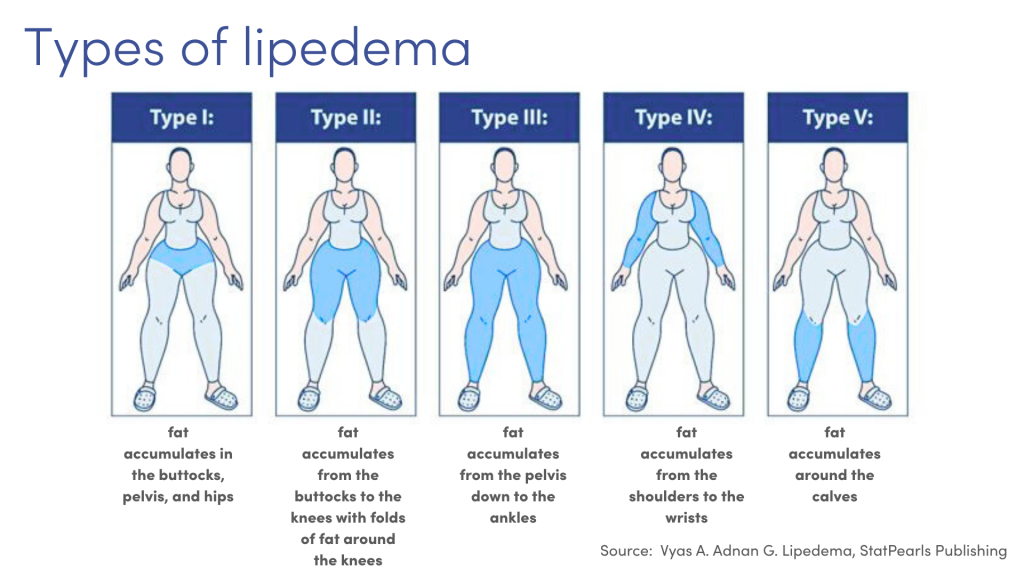
Did you know there are actually five different types of lipedema?
Each type is defined by where the abnormal fat accumulates in the body. Type I affects the buttocks, pelvis, and hips. Type II extends further down, from the buttocks to the knees — often with folds of fat around the knee area. Type III reaches all the way from the pelvis down to the ankles. Type IV is unique in that it affects the arms, with fat accumulating from the shoulders to the wrists. And Type V is isolated to the calves. It’s also possible to have more than one type at the same time, which is part of what makes lipedema so individual — and why a specialist like Dr. Salazar takes a personalized approach with every patient.
Why Does It Go Undiagnosed So Often?
Lipedema is frequently mistaken for obesity, lymphedema, or chronic venous insufficiency — even by healthcare providers who aren’t familiar with it. Many women spend years being told to just “lose weight,” without anyone recognizing what’s actually going on.
That misdiagnosis (or complete lack of diagnosis) can take a serious emotional toll. When you’re doing everything “right” and not seeing results, it’s easy to internalize that as failure. Recognizing lipedema as a legitimate medical condition — not a lifestyle problem — is a huge first step toward healing, both physically and emotionally.
What Are the Stages?
Lipedema progresses through four stages:
- Stage 1: Skin is smooth, but fat deposits are noticeably enlarged
- Stage 2: Skin becomes uneven with larger nodules underneath
- Stage 3: Large tissue buildups cause visible deformations
- Stage 4 (Lipo-lymphedema): The lymphatic system is also affected
Early diagnosis matters. Catching lipedema in the earlier stages gives you more options and may help prevent progression to more advanced stages.
How Is It Diagnosed?
If several of these sound familiar, it may be time to talk to our specialist, Dr. Salazar.
There’s no single blood test or imaging scan that definitively diagnoses lipedema. Instead, diagnosis is based on a detailed patient history, physical examination, symptom evaluation, and family history. Since it often runs in families, knowing whether a mother, aunt, or grandmother had similar symptoms can be a helpful piece of the puzzle.
Symptoms often become more noticeable during hormonal shifts — puberty, pregnancy, and menopause are common turning points.
What Are the Treatment Options?
The good news: there are real options. Treatment is usually a combination of conservative approaches and, in more advanced cases, surgery.
Conservative treatments focus on managing symptoms and slowing progression:
- Compression garments
- Manual lymphatic drainage
- Myofascial release
- Anti-inflammatory diet and regular movement
- Other supportive therapies like acupuncture and dry needling
These approaches can make a meaningful difference in pain and mobility — even if they don’t eliminate the fat deposits entirely.
For more advanced cases, liposuction can be highly effective. When performed using Dr. Salazar’s specialized techniques that protect the lymphatic system, it can remove lipedema fat with lasting results. The fat that’s removed doesn’t come back, which can provide significant, long-term relief from pain and mobility issues. It’s not a cure, but for many patients, it’s genuinely life-changing.
The Emotional Side of Lipedema
Living with a condition that’s been misunderstood — sometimes even by your own doctors — is exhausting. Many women with lipedema experience feelings of frustration, isolation, and depression before they ever get a proper diagnosis.
That’s why the emotional and mental health piece is just as important as the physical treatment. Support groups, counseling, and connecting with others who truly get it can make a huge difference. And so can simply having a care team that takes you seriously.
At LJCSC, Dr. Salazar approaches every lipedema patient with that in mind. You deserve answers, a real plan, and a provider who listens.
You Don’t Have to Figure This Out Alone
If any of this sounds familiar, we want you to know there are answers and people who can help. Dr. Salazar is here to walk you through your options in a way that makes sense for your body and your life.
June is Lipedema Awareness Month — and there’s no better time to start the conversation. ?
Schedule a consultation with Dr. Salazar
? Additional Resources
Want to go even deeper? We’ve got you covered.
?️ Podcast: “The Truth About Lipedema”

Dr. Salazar sat down with world-renowned lipedema expert Linda-Anne Kahn for a candid, eye-opening conversation about this misunderstood condition. Linda-Anne is the President of Lymphatic Therapy Services of San Diego and an internationally acclaimed practitioner with over 35 years of experience treating lymphedema, lipedema, Dercum’s disease, chronic venous insufficiency, and more. Trained at prestigious institutions including the Dr. Vodder School in Austria and the Dr. Foeldi School in Germany, she’s a certified expert in Manual Lymph Drainage — and her integrative approach blends lymph massage with nutrition, essential oils, and lifestyle counseling. She’s also the author of Lymphedema and Lipedema Nutrition Guide: Foods, Vitamins, Minerals, and Supplements, and was herself diagnosed with lipedema in the 1990s. She brings both clinical expertise and deeply personal insight to this conversation. Click here to watch or listen
? On-Demand: Lipedema Live Event with Dr. Salazar
Missed our live ON24 event on lipedema? No worries — you can watch the full recording on demand. Dr. Salazar covers diagnosis, treatment options, and answers real questions from attendees. It’s a great resource whether you’re newly curious about lipedema or have been navigating it for years. Watch the on-demand recording
? Follow Us on Instagram: @lipedemasandiego
Want a steady stream of lipedema education, tips, and community? Follow our dedicated lipedema Instagram page for content designed to inform and empower. #LipedemaAwareness
Follow @lipedemasandiego on Instagram

? Take the Quiz
The Lipedema Project has a 9 question quiz to help you know if you have lipedema. Click here to find out.
