

Men aren’t loud about plastic surgery. They never really have been. But something has shifted — Botox and skincare regimens have gone mainstream on social media, and little by little, men have stopped treating “getting something done” as a secret. They’ve just kept doing it quietly, deliberately, and with a very specific goal: to look like a rested, sharper version of themselves. Not a different guy. Not “surprised.” Just better.
That’s the line every good plastic surgeon walks with male patients — and it’s the line this article is about.
Rule One: Nobody Should Be Able to Tell
Ask any man considering a procedure what he’s most afraid of, and it’s rarely the surgery itself. It’s looking obvious. Overdone. Feminized. Like he tried too hard.
Board-certified plastic surgeon Dr. Hector Salazar hears it constantly in consultations, and he designs around it. The techniques men gravitate toward — a subtle brow adjustment hidden in the temple hairline, eyelid surgery timed to a natural crease, an incision placed exactly where a smile line already falls — share one goal: results that read as rest, not surgery.
Even Botox, Dr. Salazar points out, has quietly replaced many brow lifts that used to be standard. A little neurotoxin lifts the outer brow just enough to look alert instead of tired — no incision required. When an incision is needed, it’s tucked into the hairline at the temple, addressing only the outer corner of the brow. Go too far into the center of the forehead, though, and you run into the single biggest pitfall in male facial surgery.
The Brow Lift Trap
If there’s one warning worth repeating to any man researching a facelift, it’s this: a full brow lift is one of the most feminizing procedures in plastic surgery — and it’s frequently done wrong on men.
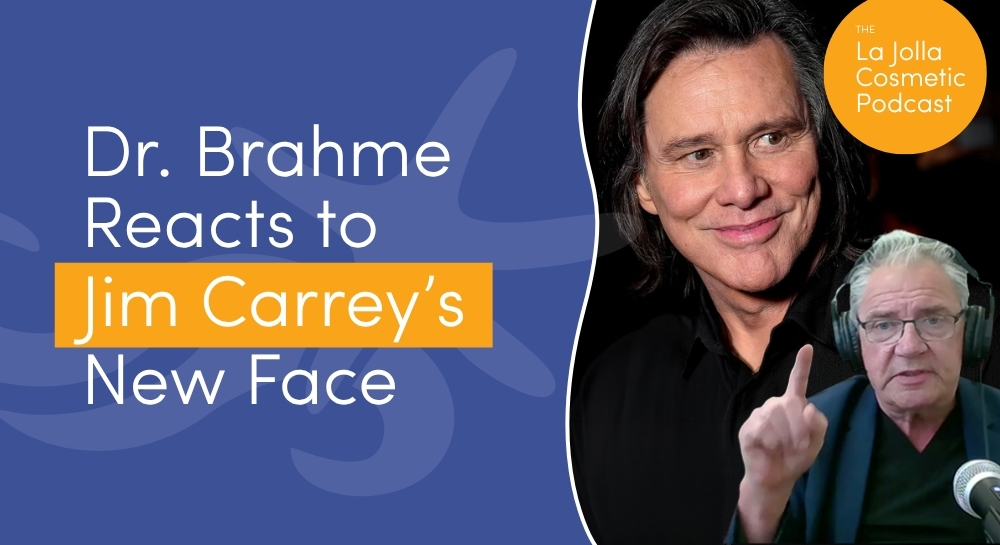
Dr. Johan Brahme, who has performed well over a thousand facelifts, put it bluntly while analyzing the internet’s favorite “did he get work done?” mystery of the year, actor Jim Carrey. Elevating the middle of the eyebrow — the part that should stay put on a man — is what produces that permanently startled, wide-eyed look. Dr. Brahme has done hundreds of facelifts on men. Brow lifts on men, in comparison, he’s done only a couple of times. Why? Because the alternative, a conservative upper eyelid lift, quietly does the job without changing the shape of the face at all.
The takeaway for men isn’t “avoid surgery.” It’s “avoid a surgeon who treats your face like a woman’s face.” The eyebrow has an inner region, a middle, and an outer region — and on a man, only the outer corner should generally move.
The Neck: Public Enemy Number One
If there’s a procedure men actually bring up unprompted, it’s the neck. The “turkey neck.” The loose skin under the chin that shows up in every selfie taken from slightly below eye level.
For milder cases — where it’s really just a layer of stubborn fat under the chin rather than loose, hanging skin — liposuction of the neck alone can be enough. A few small, well-hidden incisions remove the fat directly, sharpening the angle between the chin and neck without excising any skin. It’s the least invasive option on this list, and for the right candidate—younger skin, mild fullness, no significant skin laxity—it can deliver a surprisingly crisp jawline on its own.

For men who don’t want — or don’t qualify for, due to hair loss — a full facelift, and whose issue is loose skin rather than fat, Dr. Salazar performs a more targeted procedure called a T-Z Plasty: a direct excision of the excess skin from chin to Adam’s apple, closed with a specialized cutting pattern (hence the name) that redistributes tension and re-creates a defined jawline. It’s a technique few surgeons perform, in part because working directly on the problem — rather than pulling the skin tight from the ear, as in a traditional facelift — takes real skill to close well. Done right, the resulting scar fuses into the natural creases under the chin and is essentially invisible in normal conversation. We can also add nanofat to help the scar heal faster and be even less noticeable.
Recovery is short by plastic surgery standards: real activity resumes in two to three days, desk work is usually fine within a week, and most patients are camera-ready in ten days to two weeks with the help of a discreet compression garment (“jaw bra”) worn under a collar. Dr. Salazar’s own rule of thumb: instead of a two-week recovery trip to Europe, think a quick trip to Cabo.
For men who do want the full result — neck plus eyelids — Dr. Salazar has a name for the combination that keeps coming up: “T-Z and eyes for guys.” Two procedures, one recovery window, a face that looks rested rather than remodeled.
The Midsection: Definition, Not Transformation
The other conversation men have quietly, usually a decade or two after they first notice it: the midsection just isn’t what it used to be.

For a lot of men, it starts at the sides — that stubborn band of fat along the flanks, often called “love handles,” that shows up no matter how consistent the gym routine is. It’s one of the most common trouble spots because it tends to resist diet and exercise more than fat elsewhere on the body; genetics decide a lot more about where fat sits than effort does. It’s also one of the more straightforward areas to treat, since the fat there tends to sit close to the surface and respond well to liposuction, often with results that hold steady once the area is addressed.
High-definition liposuction (HD lipo) has become the answer for men who want visible muscle definition back — not manufactured, but revealed. The technique works by removing fat directly around a patient’s existing muscle contours (asymmetries and all — nobody’s building a six-pack that isn’t already there) and by tightening the fascia, the tough connective layer beneath the skin that actually holds your midsection in, more than muscle does. Done in a full 360-degree pass around the abdomen, flanks, and lower back, the retraction effect can rival a tummy tuck without the long incision — and the incisions themselves are hidden in the belly button and below the waistband, healing down to barely visible lines.
The same conversation often leads to a topic most men don’t realize is common: up to 65% of middle-aged and older men develop excess breast tissue, or gynecomastia. The fix depends entirely on what’s actually there — soft fat responds well to liposuction alone, while denser glandular tissue may need a small, separate excision. A proper in-person evaluation is what determines which (or both) a given patient needs, and Dr. Salazar is clear that this and HD lipo are generally staged separately — tissue needs room to heal, and there’s no version of plastic surgery where more, all at once, is better.
The trade-off worth knowing upfront about gynecomastia surgery: full results take a few months, not a few weeks. Patients feel normal within days, but confidence to be shirtless with friends takes a season, not a weekend.
The Fat You Already Have, Put to Better Use

Here’s a detail most men don’t know until they’re sitting in a consultation: the same fat removed from the abdomen or flanks during liposuction doesn’t have to be discarded. It can be processed and reinjected into the face—a technique called fat transfer (or fat grafting)—to restore volume that simply fades with age.
Dr. Brahme uses it on nearly every facelift he performs, not as an add-on but as a core part of restoring a natural look. The areas that benefit most are the ones that hollow out first: the cheeks, the crease that runs from nose to mouth, the area in front of the jowls, and the temples, which sink in with age in a way that reads as “tired” or “older” faster than almost anything else on the face. Because it’s the patient’s own tissue, a meaningful portion of it — roughly 60%, in his experience — becomes permanent.
There’s one place Dr. Brahme deliberately avoids injecting fat: the lower eyelids. The skin there is thin enough that fat grafting can look puffy and lumpy in a way that’s very hard to reverse, unlike dissolvable filler. It’s a good example of why “more volume everywhere” isn’t the goal — the goal is restoring specific structure with the right tool in the right spot, which is really the theme running through every procedure on this list.
Combined with body contouring, it means a single recovery period can address two things at once: a tighter midsection and a fresher, less hollow face — using material the body already had lying around.
Hair, and the Full Picture
Hair restoration rounds out the conversation for a lot of men, and it’s typically the one they’ve thought about longest before finally calling. The approach ranges from non-invasive — topicals, targeted vitamins — to transplantation, with the treatment plan built around what will actually work for a given hairline rather than a one-size-fits-all answer.
What Dr. Salazar sees most often, though, is men combining categories: a hairline refresh, an eyelid lift, a T-Z Plasty for the neck. Individually, each is subtle. Together, patients describe it the way he does — less like a single procedure and more like turning back the clock twenty years, while still looking unmistakably like themselves.
The Real Advice: Start the Conversation Earlier Than You Think
Both surgeons converge on the same closing point, and it’s less about anatomy than timing.
Dr. Brahme notes that surgery performed on younger, more elastic skin tends to produce results that are both more subtle and more durable — which is a case for an earlier conversation, not a later one, especially for men already noticing early changes. And the data backs up what a lot of men already suspect about themselves: most people think about a cosmetic procedure for about two years before they actually book a consultation.
That gap doesn’t have to exist. A consultation is not a commitment — it’s information: candidacy, incision placement, real recovery timelines, real cost. Nobody has to know a man’s on his way to that appointment, and nobody has to know afterward, either.
Curious what a refresh could look like for you? La Jolla Cosmetic Surgery Centre offers a free, confidential consultation with board-certified plastic surgeons who specialize in these exact procedures for men. Contact us to start the conversation — on your own timeline, entirely between you and your surgeon.
